
All Things Wedding MC
You spend hours of time, loads of energy, and a lot of money making sure your wedding day will be perfect. As you work to bring your plans together, your wedding will begin to develop a personality (aka a vibe, feel, or mood). Usually the personality your wedding takes on is a reflection of your own. As the primary source of communication to guests, a professional MC conveys this personality to the guests. Of course this person isn’t you and they will have their own unique personality to bring to the table, but it is important to find a professional who will accurately represent you, your fiance, and your wedding vision! Follow this guide to make sure you feel confident in the MC you select!
This guide is divided into 3 sections:
Things to know and consider prior to booking a wedding MC
Questions to ask an MC prior to booking
Ways to maximize your MC’s services
You spend hours of time, loads of energy, and a lot of money making sure your wedding day will be perfect. As you work to bring your plans together, your wedding will begin to develop a personality. Usually the personality your wedding takes on is a reflection of your own. As the primary source of communication to all wedding attendees, a professional MC conveys this personality to everyone. Though this person will bring their own unique charisma to the table, it is important to find a professional who will accurately represent you, your fiance, and your wedding vision! Follow this guide to make sure you feel confident in the MC you select!
This guide is divided into 3 sections:
Things to know and consider prior to booking a wedding MC
Questions to ask an MC prior to booking
Ways to maximize your MC’s services
Things to know and consider prior to booking a wedding MC
What is an MC? An MC (Emcee), or Master of Ceremonies, is essentially the voice of your wedding. They are the liaison between you, your vendors, your timeline, and the guests. Not to be confused with a coordinator, who communicates between you and your vendors to make sure everything is running smoothly and on time, an MC communicates between the coordinator and guests to keep everyone informed of what will happen next. In addition to making important announcements, they typically also provide an element of entertainment to the guests.
You need someone to MC. The role that an MC plays is a big piece of what separates a wedding from any other event. Even if you aren’t interested in hiring an MC as an entertainer, someone will still need to be designated to make announcements. Without an MC the guests, or even you, might not know what to do at any particular time. For example, the MC will direct people from one area to another (ceremony, to cocktail hour, to reception, to dancing, etc.), release tables to take turns at a buffet, announce when the bar is open and closed, introduce special events (i.e. the grand entrance, special dances, toasts, etc.), and bring energy to the dance floor!
Typically your musician will double as, or provide, an MC, but this isn’t always the case. Typically the DJ or lead singer of a wedding band will serve as an MC. If they don’t personally act as an MC, they usually offer an MC as an add-on to their services. Sometimes these professionals don’t include or offer options for this service, and you will need to find a professional on your own. In some cases, even if your musician can MC, a separate professional may be necessary if announcements need to made in multiple languages. When booking a musician, inquire about their MC work, and/or request an MC that is bilingual if necessary.
Professionals specializing MC work usually have a very specific style. Some people specialize in wedding MCing, but it is more common to find an MC who specializes in events as a general category. While anyone MCing will have their own “microphone voice,” professionals who specialize in this kind of work tend to have more niche styles. A professional MC may host game night at a local bar, fashion shows, bingo nights, drag shows, standup comedy shows, etc., all of which require a niche persona. This means they are likely to have a specific MC style that may or may not work for you. You can judge this based on samples of their work they provide, how they speak on the phone, or by attending an event they are hosting prior to booking.
Some MCs double as musicians; proceed with caution. Not to be confused with musicians who double as an MC, some professional MCs also dabble in music on the side and may want to do a performance at your wedding. Again, be sure to check out samples of their work to make sure this is something you are comfortable with! Sometimes it works out amazingly, and they offer an incredible show to guests. Sometimes it goes less than stellar. Do your due diligence and make sure any performance they will do will go over well with your specific crowd.
Some MCs double as comedians; proceed with caution. MCs are almost always at least a little funny and charismatic. This makes for a great host! Guests don’t want to hear a monotone voice making bland announcements. Often lack of character allows for announcements to go unheard, as even an amplified monotone voice is easily lost in the noise of the crowd. However, there is a difference between a little bit of charming humor and a full on stand up routine. Even if you love comedy and a full stand up routine sounds awesome, make sure that their sense of humor is in line with what you envisioned for your wedding!
An MC is an entertainer, but they shouldn’t steal the show. As the host of your wedding, an MC is expected to provide entertainment for guests. This may include walking around to guests and asking them questions about the newlyweds, encouraging guests to dance, or making announcements in an upbeat and engaging way. There is an incredible finesse required to provide entertainment without making the day about themselves. This is easily avoided by checking out their work prior to booking!
MCs don’t usually provide their own sound equipment. Since it is unusual for MCs to provide their own sound equipment, you will need to source this elsewhere. Typically your DJ, venue, or wedding band will provide the sound equipment. Make sure that whoever is providing sound equipment is on board with sharing. If none of these vendors are supplying a sound system, you will need to source it elsewhere so music and announcements can be heard throughout your event space.
Meet with a potential MC you are interested in on the phone or in person and pay attention to their speaking voice. Listen to the cadence of their voice. Pay attention to their energy, word choice, personality, and overall sound they produce when they speak. This will provide a lot more insight into their MC style than any single question ever could. If the person is engaging, interesting, and professional in a meeting, there is a good chance those qualities will carry over to their MC work.
Don’t just read reviews, read into reviews. An MC may have five stars across all review platforms, but that doesn’t necessarily mean they are a good fit for you. While this is true for all vendors, it is especially true for MCs because their work style is so subjective. Look for trends in the reviews that can provide a little more insight into what this professional's work style is like. For example, if you see multiple 5 star reviews that consistently say something to the effect of “they playfully teased all of our guests and did a lot of funny celebrity impressions,” recurring throughout reviews, that person is probably going to perform similarly at your wedding. Other couples may have loved this and left all five star reviews, but if the thought of your guests being the butt of a joke and having to listen to celebrity impressions all night makes you cringe, that professional isn’t going to be the right fit for you.
Questions to ask prior to booking an MC
Basics-
Are you available on my date?
Can you work within my budget?
Do you require a deposit? How much?
When is the balance due?
What is your preferred method of payment?
What is your cancellation policy if I cancel?
What is your cancellation policy if you cancel?
What is your rescheduling policy if I need to change my date?
What is the backup plan if you are personally unable to fulfill your contract due to a last minute conflict?
Are there any additional fees, such as travel fees, that are not included in the package price?
Are you licensed?
Are you insured? Does the insurance cover all of your staff and property?
Experience & style-
How long have you been a professional MC?
Do you specialize in a certain type of event?
How long have you been MCing weddings?
How many weddings have you MCd?
How would you describe your MC style?
What makes you stand apart from other MCs?
Are you open to hosting games or special events we have planned?
Do you offer any additional services or typically do special performances?
Have you worked at our venue before? (Hint: This is particularly important if the venue includes a house sound system. An MC that is familiar with your venue and their system will be familiar with how to start up the system and quicker able to troubleshoot, should any issues arise.)
Have you worked with our musician(s) before?
If applicable, can you make announcements in English and another language? (Hint: Typically at multicultural events a special MC will be hired to make announcements so that all of the guests can understand. Usually these MCs will make announcements in English and your preferred language, but some MCs will only make announcements in the language you have specifically hired them for. This can pose an issue if some guests don’t speak this language, and creates the same problem they were hired to alleviate in the first place! Make sure that someone is available to translate for guests so everyone is in the know for important events!)
Can we see videos of you hosting a previous event or attend a live event that you are MCing?
Logistics-
Do you provide your own sound equipment?
If you do provide sound equipment, will our guests have access to your microphone for speeches/toasts?
If we decide we want the party to last longer, can we add extra hours onto our package on the night of the wedding?
What is the rate for additional hours?
Do you require breaks?
Do you require a vendor meal?
Will you MC any other events throughout our wedding weekend?
Ways to maximize your MC’s services
Set up a phone or in person meeting prior to the wedding to go over all of the details. It is important that the MC is well versed in all of your wedding day plans so they can do their job to the best of their ability. In order to set themselves up for success, most MCs will require either a phone or in person meeting prior to your wedding to go over the details. If they don’t require a meeting, arrange one yourself! Everyone will be better off if the details are reviewed together in advance. This meeting will be most beneficial within the final week or two of your wedding. As you finalize planning details, slight things may shift. Set up your meeting with your MC as close to your wedding as possible (without it being so close that the MC doesn’t have time to prepare and you feel overwhelmed with a lot of last minute to-do’s) to ensure they are receiving the most finalized and accurate information regarding your wedding plans.
Send the MC your timeline prior to having a final details meeting with them about your wedding plans. This will give the MC an opportunity to look through the timeline and prepare any questions they may have for you. The MC will need to be familiar with the timeline to make sure they understand the flow of the evening, when to make announcements, and, on the day of your wedding, know when to check in with your coordinator and other vendors to make sure everyone is ready for the next scheduled event prior to making the announcement.
Specify how you, the newlyweds, would like to be referred to. Your MC will be announcing, at least referring to you, several times throughout the evening. Make sure you specify what you’d like to be called as a couple. While traditionally newlyweds used to be referred to as “Mr. and Mrs. [man’s full name here]” that isn’t always the case anymore. With so much variation in who can be married and the dynamic between couples shifting, weddings have come a long way from the days where new couples were introduced as “Mr. & Mrs. John Smith!” Some other alternatives include just your first names, “the newlyweds,” “the Smith’s,” “John & Philip Smith,” etc.
If you need your MC to announce any names, spell the names out phonetically. Even simple names get mispronounced on occasion. An easy way to avoid this is to write out the phonetic spelling next to the names so the MC knows exactly how to say the names (i.e. Mary = M-air-ee). Write out your name, your fiance's name, and your last name(s) phonetically so the MC pronounces them correctly all evening long. Even if you talk to your MC many times and you and/or they say your names repeatedly, it is YOUR special day and your names are worth guaranteeing correct pronunciation! Usually more than just the newlywed’s names will be announced at some point during the wedding. Important guests will give speeches and often newlyweds want to include additional people in the grand entrance (i.e. the wedding party, immediate family members, sponsors, etc.). Provide these names in writing with specifications on how to pronounce them, so everybody’s name is announced correctly!
Thoroughly discuss any announcements your MC will need to make. Prior to the wedding, you will likely plan and predetermine specific announcements that will need to be made. Make sure to provide these announcements in writing to your MC. The timeline is the perfect place to write out the specific announcements so the MC can track exactly when announcements are intended to be made. Be sure to discuss all of the announcements with your MC. Let them know if you want the exact wording you have provided, or if they have a little leeway on what should be said.
Let the MC know ahead of time when to NOT speak. Some people only want the MC to speak when it is time for designated announcements. Others want entertainment all throughout the event. Many people want something in between. If there are any times throughout the night you’d rather the MC keep to themselves (i.e. special dances, the duration of dinner, the duration of cocktail hour, etc.) let them know ahead of time. If the MC isn’t given any specifications of when to keep quiet, they may feel the need to fill in gaps by telling jokes, narrating special events (i.e. “wow look at that twirl,” “Oh they’re going for dip,” “smash the cake!!”, etc.), or engaging guests on the microphone (i.e. inquiring about how they know the couple, asking for a random guest to provide relationship advice, asking for a quick impromptu speech from a random guest, etc.). All of these examples are fairly typical of an MC, so they can’t be blamed for doing any of this if they haven’t been told otherwise!
Discuss specific jokes, questions, games, etc. that you’d like included with your MC. If there is anything specific or out of the norm you’d like included at some point at your wedding, let the MC know! If you want any games, specific forms of guest engagement, or other out-of-the-norm approaches to entertainment make sure the MC knows ahead of time so they can prepare accordingly! While the examples listed under #6 are not out of the norm for MCs, they also shouldn’t be expected unless you specify you would like them to engage and entertain guests in these ways.
Be sure to inform the MC of any “don’t breach topics.” If there is anything that should never, ever be brought up with your family or guests LET THE MC KNOW! There is nothing worse than an MC making a statement, telling a joke, or asking a question and it being followed by a dramatic, awkward pause amongst the crowd! The best way to avoid this is to let them know about any “don’t go there topics” ahead of time. Even if it feels like an overshare, it will be better for everyone in the end if the MC knows what topics to avoid.
Specify who should and should not be given a microphone. It is fairly common for a distant relative or friend to suddenly become inspired and want to give an impromptu speech at a wedding (especially once the alcohol starts flowing). Some couples are happy to open the floor to anyone who wants to give a toast, while others strictly want to stick to the planned speeches. There are any number of reasons for either of these approaches, but if you anticipate any guests becoming an issue, make sure your MC knows who, under no circumstances, should never get a hold of the microphone.
Provide all information in writing. While a phone or in person meeting is of the utmost importance, it is equally important to write down all instructions, wants, dislikes, etc. for your MC. While it is important that information is provided in writing for all vendors, it is especially important for your MC, because their mistakes are amplified (literally, via the microphone). If your caterer forgets to set out appetizer plates, they can quickly fix the problem with minimal guests noticing. If your MC messes up your last name, everyone will be aware. Your MC will likely be pouring over your written notes prior to the wedding in order to prepare, but will typically bring all of the notes with them to make sure everything is going the way you discussed! Little details are much more likely to slip by the wayside if they don’t have written notes and are simply trying to remember everything you said in a phone conversation! This will also help if your coordinator or a guest approach the MC to inquire why they are or are not doing something. If the MC has specific instructions in writing that they are not supposed to tell jokes or engage with guests during dinner they can prove they are doing their job exactly as you wanted!

Preparing and Planning Your Wedding Ceremony
Your wedding ceremony is the start to your married life. This is what guests are here to celebrate! Follow this guide to make sure your ceremony is the perfect beginning to your wedding celebration and life as a married couple!
This guide is divided into 3 sections:
Writing your wedding ceremony
Walking order for the ceremony
A series of Pro-tips on things to consider when planning your ceremony
Your wedding ceremony is the start to your married life. This is what guests are here to celebrate! Follow this guide to make sure your ceremony is the perfect beginning to your wedding celebration and life as a married couple!
This guide is divided into 3 sections:
Writing your wedding ceremony
Walking order for the ceremony
A series of Pro-tips on things to consider when planning your ceremony
Writing your wedding ceremony
Typically the person officiating your wedding will prepare the wedding ceremony, but there are plenty of reasons you may need to create your own. When it comes to writing a wedding ceremony, there are very few rules. The only piece you absolutely need is an exchange of some sort of committal statement that both parties involved in the marriage recite. This is the “Do you X, take X to be your lawfully wedded...“ part of the ceremony. Even this part can be customized, but there are a few basic sentiments that need to be included.The rest is completely up to you!
A standard flow to a wedding ceremony is as follows:
Guests asked to take their seats (usually about 5-10 minutes prior to the ceremony start time, depending on how many guests you are expecting)
Everyone participating in the ceremony is lined up (usually this includes the wedding party, immediate family, flower girl, ring bearer, bride(s), and/or groom(s)- (the order everyone walks in will be discussed in the next section of this guide).
The processional starts (this is the music that everyone will walk down the aisle to) and everyone enters in their pre-discussed order to their predetermined locations
Everyone except the bride and her escort(s) (if she chooses to have any) are in their places, whether it be seats or at the altar
The bride and her escort(s) walk down the aisle
The officiant welcomes & thanks everyone in attendance
(in a religious ceremony) the officiant leads a prayer.
The officiant introduces themself & describes their significance in the ceremony (they may describe their friendship with the bride(s) and/or groom(s), their role as a religious leader, what qualifies them to lead this ceremony, etc.)
The officiant tells a personal anecdote about the bride(s) and/or groom(s) (This can be anything! Sometimes it is a story of how the couple met, a description of a common theme throughout their relationship, a funny story they shared with the officiant, etc.)
Words of wisdom are offered to the couple (this can either be advice coming directly from the officiant, a reading- religious or other- by a friend or family member, or a meaningful song either played or performed live by a musician or friend/family member, etc.)
Special ceremonies typically occur next if they occur at all (i.e. sand ceremony, cord ceremony, candle lighting ceremony, glass ceremony, etc.)
The couple will exchange vows (this can be standard vows or personal vows prepared by the couple)
The couple exchanges rings (this is the “I Do’s” part!)
Final closing thoughts from the officiant (this can be a closing prayer, well wishes to the couple, etc.)
The pronouncement of the marriage (“I now pronounce you…”)
The kiss
The recessional music begins (exit song) and the couple exits together
Once the couple is all the way back up the aisle the bridal party follows them
Following the bridal party’s exit, the ushers will escort immediate family members up the aisle
Once all family members are back up the aisle, the officiant announces that guests are released and gives direction on what to do next (head to cocktail hour, leave for the reception venue, pose for a group picture, etc.)
While this is a common ceremony flow, you can choose to rearrange this however you want. Certain religions will have additional traditions incorporated throughout the ceremony. Some people will choose to have multiple readings and/or performances spread out throughout their ceremony while other couples choose to exclude many pieces listed here. As long as you exchange promises in some sort of ceremonial format, the marriage is legal and the rest is up to you!
Walking order for the ceremony
Depending on how formal your wedding is, how extensive the guest list is, your relationship with your family members, and who you each choose to escort you down the aisle (if you choose to have anyone at all), your ceremony walking order can be anything! Some couples choose to only have themselves walk down the aisle, others choose to include all of their “VIP” guests. Plenty of people choose to have something in between. There are no wrong answers as long as you, your fiance, and the officiant end up at the altar!
The most standard walking order is as follows:
Entrance (procession)-
All guests seated
Immediate family like grandparents, parents of the bride(s) and/or groom(s) who won’t be escorting their to-be-married child down the aisle, and siblings who aren’t in the bridal party walk first (typically the siblings who aren’t in the bridal party will escort the parents who aren’t walking their to-be-married child down the aisle.) If any of these people need assistance walking or don’t wish to walk alone, you can assign ushers to escort them to their seats.
Officiant
Groom & mother (or Bride #1 and escort)
Bridesmaids and groomsmen
Maid/Matron of Honor & Best Man
Flower girl & ring bearer (depending on how many of each you have, they may walk together or separately)
Bride & father (or Groom #2 and escort)
Exit (recession)-
Newly weds
Wedding party in the reverse order from which they entered (after newly weds have completely exitted)
Immediate family with ushers/escorts
Officiant & guests (after the officiant makes an announcement for guests to leave)
A series of Pro-Tips on things to consider when planning your ceremony
List the guest arrival time on your wedding invitations 30 minutes prior to the actual ceremony start time. Some guests are punctual, others not so much. Don’t risk latecomers walking in during your ceremony and causing a disruption. If you are worried about the punctual guests being punished for being on time, a simple solution is to prepare some entertainment! Have music already playing to create some atmosphere and provide water, alcoholic drinks, snacks, games, a guest book, etc. to entertain them!
Write your vows down! No matter how much you practice or how confident you are in your memorization skills, write them out and keep a copy handy. When the time comes, you may not need them at all, but it is always better to be safe than sorry!
Write your vows on notecards. Writing vows on a phone or large piece of paper is a recipe for distraction. Keeping track of a phone before the ceremony is not fun. Other notifications may be distracting when it comes time to pull your phone out. Also, with a phone getting to the vows may be a little difficult! Nerves tend to make for shaky hands which is incredibly apparent if you brought a large, floppy piece of paper. A side effect of trembling paper is becoming hyper aware of how nervous you are when you see the page shake, which can make you more nervous! Even if nerves don’t get to you, wind might! A large piece of paper blowing around in the breeze can create a crinkling noise that is easily picked up by a microphone. Another downside to large sheets of paper is how easy it is to lose your place when reading from them. Big pages are a no no! Notecards allow you the opportunity to write big enough to keep your place, minimize distractions, and avoid obviously trembling.
Write two copies of your vows and hand a backup copy to someone responsible. With so much going on the morning of your wedding, forgetting something as small in size but incredibly vital as your wedding vows can happen. Prepare a back up copy and give it to the officiant, wedding planner, or member of the bridal party just in case!
Save your family seats. Most guests know not to sit in the front few rows of your ceremony space, but there is always one or two who don’t think about it. Make sure the people who matter most have a clear view from a front row seat! This can be done either by having reserved seat signs placed on their designated chairs, or tying a ribbon with a reserved sign across the chairs intended for family. Have your wedding planner or day-of coordinator keep an eye on those seats prior to the ceremony just in case any guests miss the memo!
Let your family know where they are supposed to sit. Even if you aren’t designating “mine and yours” sides for guests to sit during the ceremony, designate sides for the immediate family members, especially if they are walking down the aisle! This will expedite the seating process for them and alleviate any confusion once they reach the front of the ceremony area. Make sure to let them know during ceremony rehearsal where they are supposed to sit!
Consider the ceremony space and assign sides for family members accordingly. In some spaces, if your family sits on the side that you stand they won’t be able to see your face! If this is the case, have them sit on the opposite side so they get a clear view of all those beautiful emotions you are going through!
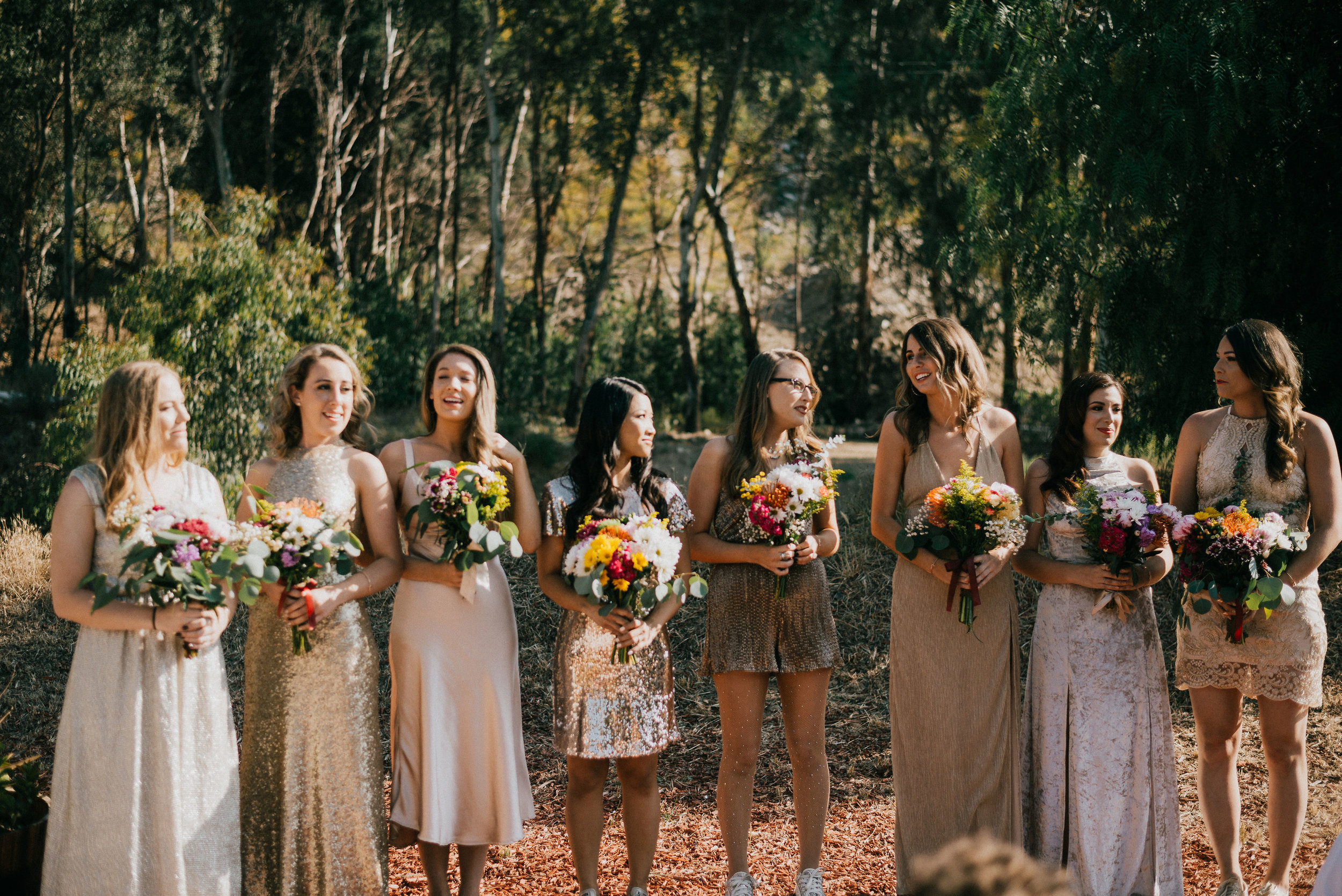
Talk with your wedding party about where and how to stand throughout the ceremony. This is what rehearsals are for! Well, not just this, but this should definitely be discussed during the rehearsal! Let your wedding party know where to stand, what angle to stand, where to hold bouquets (belly button height), etc. so the guests have a clear view and the pictures look uniform and beautiful!
Talk with the Maid/Matron of honor about adjusting the bride once she gets to the altar. The maid/matron of honor will need to fluff the bride’s dress once she settles into her standing space for the ceremony. She will also need to retrieve the bride’s bouquet when it comes time to exchange vows and rings! If there is a veil, the maid/matron of honor can also adjust this so the bride looks polished and photo ready throughout the ceremony. This is another great thing to address while running through the ceremony rehearsal!
Make sure the MC or officiant makes an announcement for guests to sit close. If you have a large ceremony area that will accommodate a guest list much larger than yours, have all of the guests move in closer prior to the ceremony starting. Not only will this give everyone a better view, it will also translate to pictures better!
Some venues have restrictions on where your photographer can take pictures from. To avoid any last minute surprises, talk with your venue about any rules and restrictions they have in regards to photography. Typically only certain religious places of worship (and even then, usually only during certain times of year) are likely to have restrictions on photography.
Your officiant will be in a lot of your ceremony pictures, so their attire is important. Not only will they be in a lot of pictures, but they will stand front and center for all guests to see! Make sure they plan to wear something professional yet simple so they don’t take too much attention away from you.
Your officiant needs to MOVE IT when it comes time for the kiss. Communicate with your officiant about quickly sliding to the side, and taking their microphone stand with them, when it comes time for the kiss and your exit from the ceremony.
Make sure whoever is in charge of your music knows all of the important cues. Discuss prior to your wedding day with the person who will be in charge of ceremony music. Let them know the signal for changing the processional songs and let them know the very last thing the officiant will say so they can use this as a cue for playing the recessional song.
Let your family and ushers know the exit strategy. Some pairs will need to change so everyone needs to know who they will enter and exit with. They will also need to know when they are supposed to leave. Occasionally the officiant will dismiss the family, but usually the family begins exiting without a formal prompt following the ceremony.
Make sure someone is lined up to make two very important announcements to guests. Guests need to be asked to take their seats and released at the end of the ceremony by someone! This can either be the officiant or the MC. Make sure the person knows they are in charge of making this announcement, when to make the announcements, and is ready to provide clear instructions on where guests should go next.
Have a game plan for yourself after the ceremony. A common oversight is a predetermined space for the newly weds and wedding party to retreat to after the ceremony concludes. Map out a space beforehand so everyone knows the plan!
Set some time aside for yourselves directly following the ceremony. After the ceremony, if possible, carve out 5-15 minutes and a secluded space where just you and your new husband or wife can be alone to process the ceremony together. The rest of the day will be a whirlwind so giving yourself the gift of peace and quiet for even just a few moments makes a big difference in how you remember the ceremony!
Ask your wedding planner, bartender, and/or caterer to have some snacks set aside for you in your hideaway space. Typically wedding party portraits and/or family portraits directly follow the ceremony, which leave you with little to no time to snack and have a drink. Ask your vendors to prepare something for you to enjoy while you take your 5-15 minute processing time so you can keep your energy level up! Make sure they give you some water, too!